

May the Fourth Be With You
What Star Wars Reveals About Liturgy and Divine Presence

May the Fourth is Star Wars Day, and I have more than a few friends who will wish me some version of “May the Fourth be with you.” Of course, as an Episcopalian, I am always tempted to reply, “And also with you.”

The pattern is familiar—but also a little deceptive. Whether in its cinematic form (“May the Force be with you”) or its liturgical one (“The Lord be with you”), there is something slightly elusive about what is actually being said. It sounds like a wish, almost a transfer, as if something is being sent from one person to another. But that instinct misleads us. May the Fourth is as good a day as any to let Star Wars teach a bit of theology.
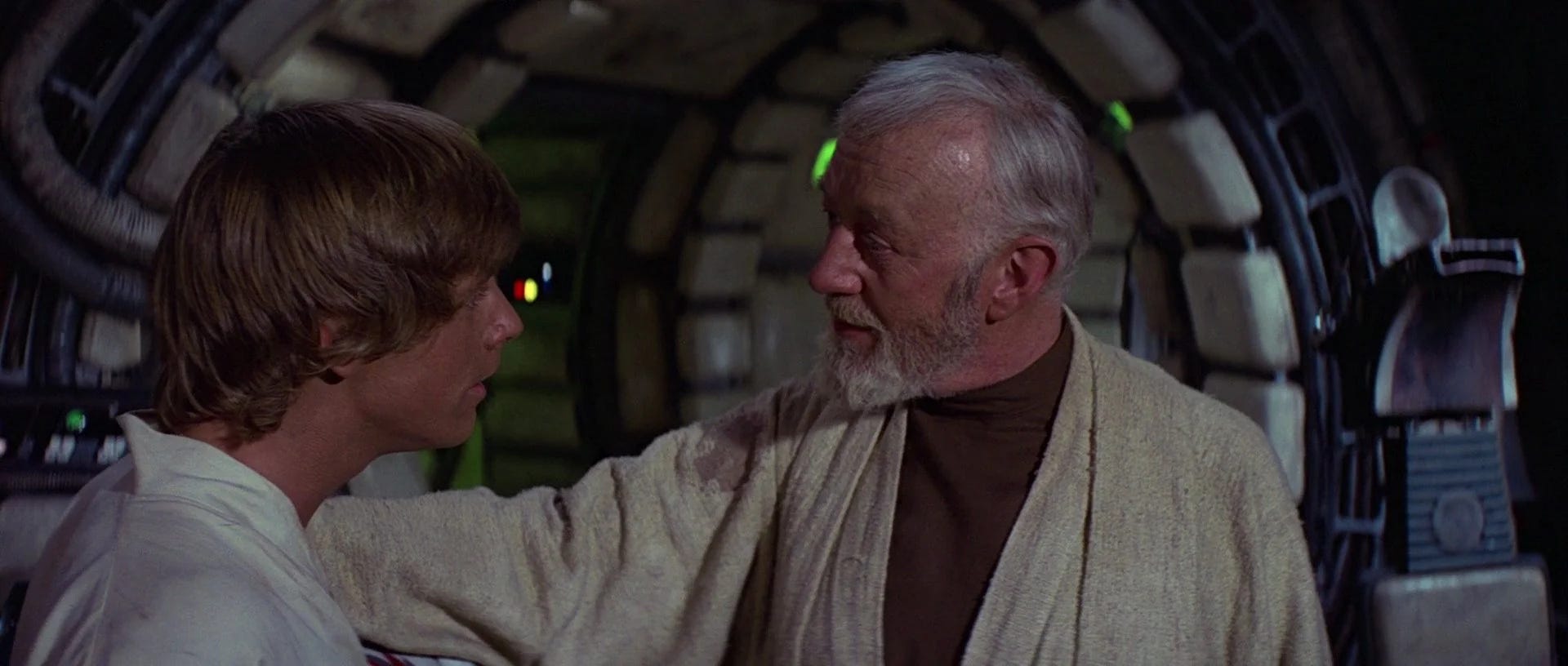
When George Lucas introduced the now-iconic line—“May the Force be with you”—he was not inventing something out of whole cloth. He was borrowing, distilling, translating. As producer Gary Kurtz later confirmed (as recounted by Chris Taylor in How Star Wars Conquered the Universe), the phrase deliberately echoes the liturgical exchange: “The Lord be with you.” And the Force itself? Obi-Wan Kenobi describes it to Luke Skywalker this way: “The Force is what gives a Jedi his power. It’s an energy field created by all living things. It surrounds us and penetrates us; it binds the galaxy together.” It is hard to miss the resonance.
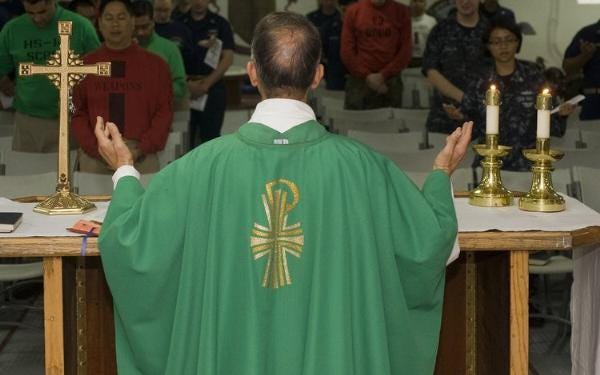
The liturgical phrase, for its part, is older than most of the institutions that now speak it. In Latin it is Dominus vobiscum. Its roots reach back into the earliest centuries of Christian worship, echoing patterns already present in Jewish prayer. It is not merely a greeting. It is a mutual invocation—a recognition. The priest does not give the Lord to the people, nor do the people supply what the priest lacks. Instead, both name what is already the case: the presence of God here, among them, within them. Not transaction, but revelation.
And that shift—from causation to revelation—is everything. The history of the Church, as grand and full of promise and grace as it is, has been slow to recognize this. Why? In no small part because of the worst impulses of being an institution. If we emphasize the transactive elements of sacrament—grace as something dispensed, controlled, administered—then the Church becomes the necessary intermediary, the sole authorized distributor, and the keeper of the record. It becomes something that can be managed, and, at times, traded upon.
The indulgence was exactly this: the monetization of sacrament and the trading of grace for gain. But its logic runs deeper than medieval indulgence abuse. It has shaped the Western imagination in ways we are still only beginning to see. There is a profound difference between recognizing the already-present Spirit of God in another person and imagining that the Church must “place it there” in Baptism.
That difference is not abstract. It has had consequences. When Puritans arrived in the so-called New World, they did not encounter a blank slate. They encountered people—complex, spiritual, already inhabiting a world alive with meaning. But their theological imagination, formed in part by a sacramental economy that located grace within the boundaries of the Church, struggled to see it. The unbaptized were not simply different; they were outside. Their humanity could be diminished, their land unoccupied. The church’s doctrine of terra nullius—“nobody’s land”—gave theological and legal cover to this distortion. Lands already inhabited were declared empty, available for taking, because those who lived there were not recognized as participants in the same sacred order.
And one cannot help but wonder. What if Puritans arrived differently? What if they had come expecting to find the Spirit already at work? Expecting that the people they met were already made in the image of God, already breathing the breath of God? What if they came expecting to see and experience light in others?
It is difficult to overstate the violence that follows when presence is denied at that level. And the logic repeats. If the Spirit is mediated through the sacraments of the Church, then those outside its bounds can be treated as less than fully human. Enslavement becomes imaginable. Forced conversion becomes justifiable. The doctrine of discovery extends the same logic across continents, baptizing conquest in the language of mission. Segregation follows, drawing lines where the image of God is confessed but not recognized. Misogyny finds footing, treating women as derivative rather than fully bearers of the divine.
The pattern is painfully consistent. Where the Spirit is confined, humanity is tiered. Where grace is controlled, dignity becomes conditional. And once that framework is in place, the list does not end—it multiplies.

And one cannot help but wonder. What if Puritans arrived differently? What if they had come expecting to find the Spirit already at work? Expecting that the people they met were already made in the image of God, already breathing the breath of God? What if they came expecting to see and experience light in others? How might the history of the Americas have unfolded if the first instinct had been recognition rather than replacement?
How might we speak, even now, about other religions, other cultures, other people, if our starting point were not absence but presence? Because the truth the liturgy points toward—however imperfectly we have grasped it—is this: the Spirit is always already there.
In Scripture, when the Spirit “comes upon” someone—when it rests on Moses, or is shared among the gathered elders in the tent; When it rushes in like wind at Pentecost —it is not as though God was previously absent and suddenly arrives. What changes is perception. Awareness. Capacity. The Spirit is not switched on; it is recognized, activated. We are, in other words, awakening to a reality already there.
The same is true, perhaps especially, in baptism. When a child is brought to the font, the Church is not installing the Spirit, as if grace were a feature to be added. It is revealing what has always been true: that the breath, the wind, the Spirit of God is already present—within, around, sustaining. Baptism does not create that reality. It names it. It marks it. It calls us to live as though it were true.

Every thing, then, is filled with the presence of God. Not in some vague or sentimental sense, but in the most concrete way imaginable: breath by breath, moment by moment, the world is held together by a life that is not its own.
“May the Force be with you”
“May the Force be with you” works not because it is clever, but because it is true in a way we half-recognize. It gestures toward a presence that surrounds and penetrates, that binds things together, that can be attended to or ignored but never entirely escaped.
And so today, when someone offers the greeting—half joke, half blessing—go ahead and receive it for what it is.
May the Fourth be with you.
And also with you.
RELATED READING
Empire Strikes Again

Star Wars is almost 50. To celebrate, one year from now the original will be back in the theaters. When I was 9 my father took me to see Star Wars and we waited in the longest line only to have tickets sell out. I cried. Some college kids saw my tears and, as they had already seen the movie several times, asked if my dad wanted to buy their tickets. The…

I Hate Jesus Movies

Movies about Jesus. I watch them of course—everything from Jesus Christ Superstar to The Last Temptation of Christ. I teach from them with clips and conversation starters. They are useful teaching tools, not because they solve anything, but because they expose how interpretation works. They show what happens when a text full meaning, ambiguity, myth, sy…
Thanks for spending time in the Studio with me.

Love this. Historically, the Church has borrowed/mirrored too much from Empire. This breaks thru that.
I forget where now, but I remember a pastor using the words, "The Lord *is* with you," (emphasis mine) instead of the more distant "May...be...". Again, don't know if it was an updated liturgy or that pastor's adaptation, but it fits well with your take.
Andrew, thank you this post. At 82, I'm still a fan of Star Wars. the original three movies. Yes, I've watched some of the others, but for me, the original three set the story in motion and yielded a way to think about Life.
My Dad was also a big fan, eagerly listening to me as I babbled on about the many references I found in the movies to what our family called the Eternal Spirit that's available and present to everyone, no exceptions.
It's time for me to replay those original three -- to get lost once again into the Eternal Mystery.
Your work is much appreciated; I'm thankful I found my way to your blog.