


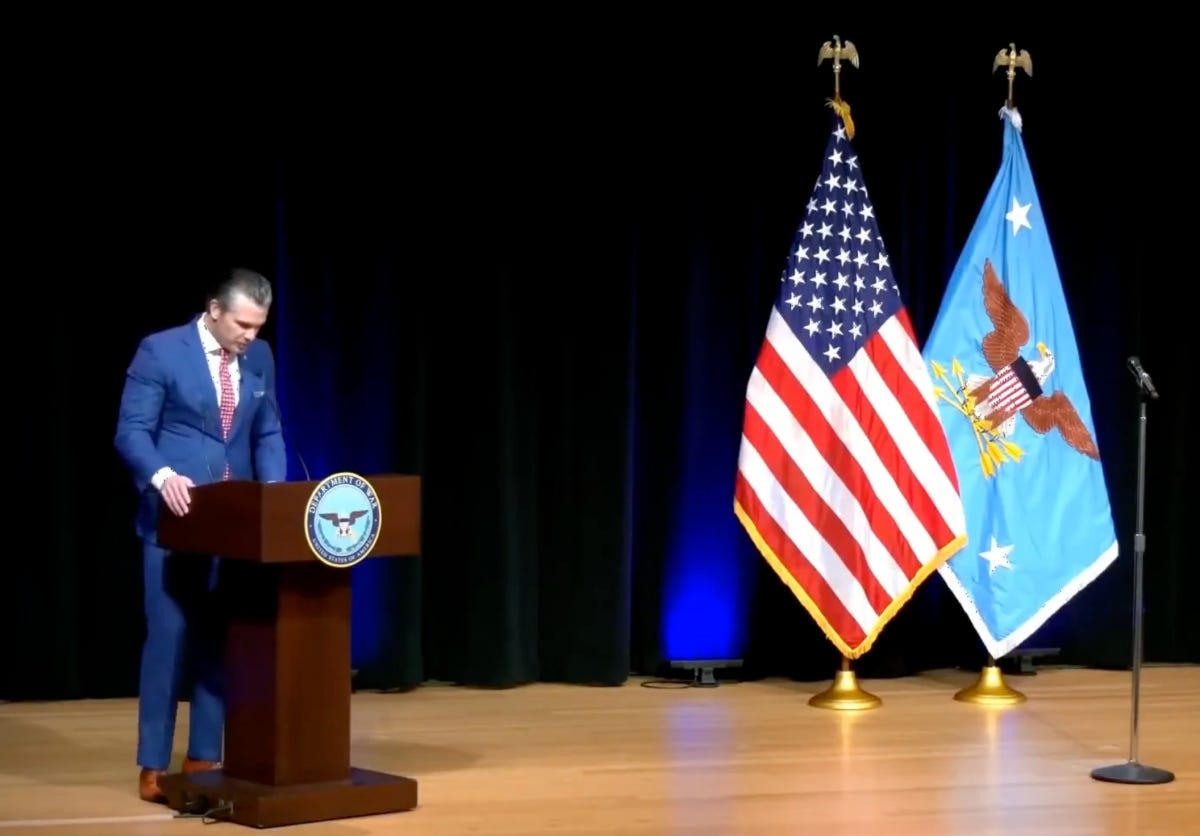
Yesterday, April 15, 2026, Secretary of War (Defense) Pete Hegseth addressed a gathering at the Pentagon and recited what he described as a military prayer called “CSAR 2517,” a title he said refers to Combat Search and Rescue and “which I think is meant to reflect Ezekiel 25:17.” At this point in Hegseth’s repeated weaponization of scripture, it may not surprise you to learn that most of the prayer was not in fact drawn from Ezekiel, but mostly from Hollywood—more Pulp Fiction than prophet, more Tarantino than Testament.
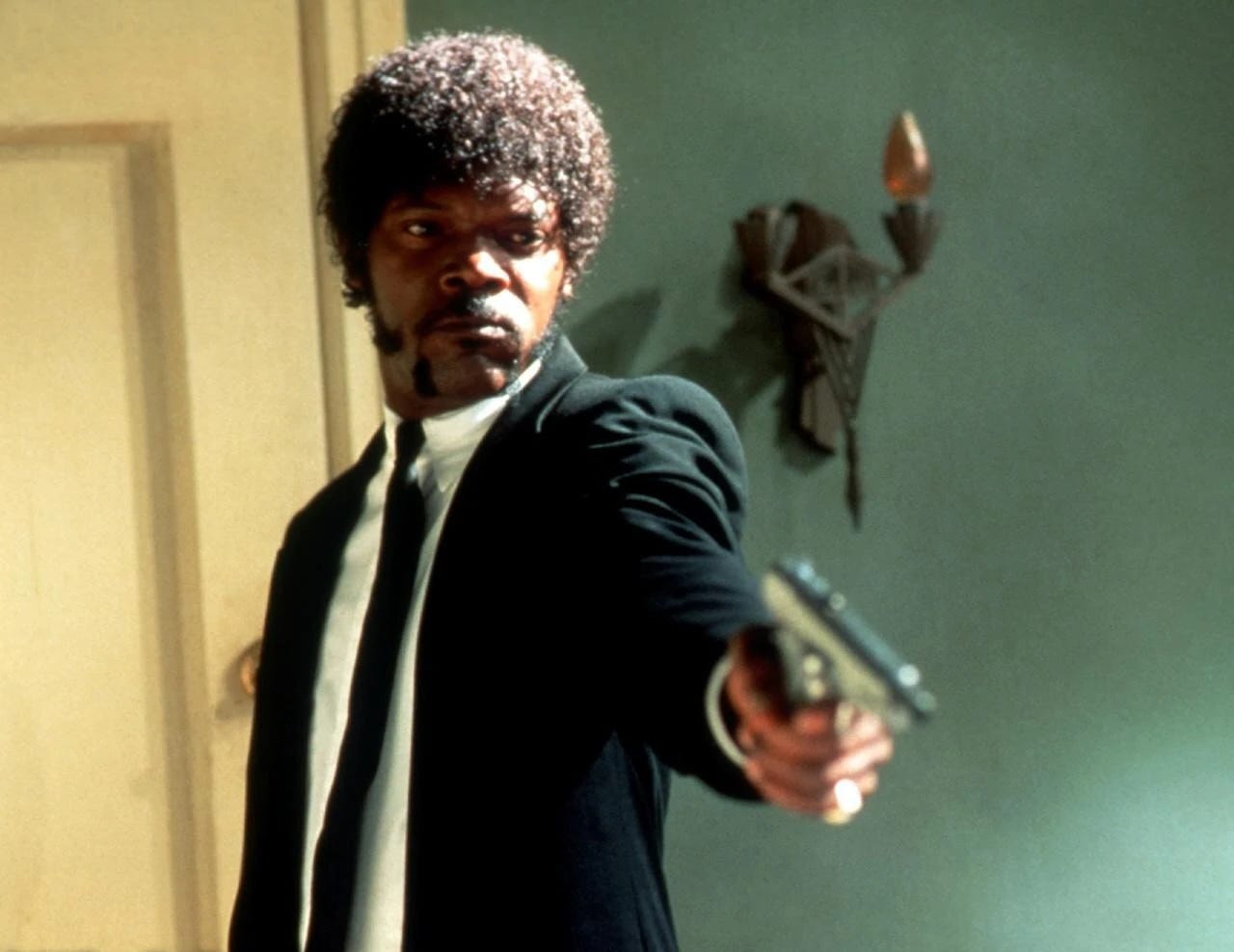
Let me give you a brief rundown of the texts actually in play here. Yes, there is some Ezekiel in the prayer—but the prayer itself is largely adapted from the speech delivered by Jules Winnfield, Samuel L. Jackson’s character in Quentin Tarantino’s 1994 film Pulp Fiction, the monologue he recites just before carrying out an execution. That monologue was itself borrowed and adapted from the opening speech in the 1976 Sonny Chiba martial-arts film The Bodyguard (Karate Kiba), where pseudo-biblical language is used to mythologize vigilante violence. What arrives at the Pentagon, then, as apparent scripture is in fact a chain of borrowed texts: a fragment of prophetic Ezekiel filtered through martial-arts revenge cinema, then through Tarantino’s gangster mythology, and finally recast as military prayer.
“The path of the downed aviator is beset on all sides by the iniquities of the selfish and the tyranny of evil men. Blessed is he who in the name of comradery and duty shepherd the lost through the valley of darkness, for he is truly his brother’s keeper and the finder of lost children. And I will strike down upon thee with great vengeance and furious anger those who attempt to capture and destroy my brother. And you will know my call sign is Sandy One, when I lay my vengeance upon thee. Amen.”
—Prayer recited by Pete Hegseth“The path of the righteous man is beset on all sides by the inequities of the selfish and the tyranny of evil men. Blessed is he who, in the name of charity and good will, shepherds the weak through the valley of darkness, for he is truly his brother’s keeper and the finder of lost children. And I will strike down upon thee with great vengeance and furious anger those who attempt to poison and destroy my brothers. And you will know my name is the Lord when I lay my vengeance upon you.”
—Samuel L. Jackson in Pulp FictionThe path of the righteous man and defender is beset on all sides by the inequity of the selfish and the tyranny of evil men. Blessed is he, who in the name of charity and good will, shepherds the weak through the valley of darkness, for he is truly his brother’s keeper, and the father of lost children. And I will execute great vengeance upon them with furious anger, who poison and destroy my brothers; and they shall know that I am Chiba the Bodyguard when I shall lay my vengeance upon them!
—1976’s The Bodyguard, aka Karate Kiba.“And I will execute great vengeance upon them with furious rebukes; and they shall know that I am the Lord, when I shall lay my vengeance upon them.”
—Ezekiel 25:17
Here they are in a side-by-side mashup.
Though Hegseth identified Ezekiel 25:17 as its source, only the closing line comes directly from the Bible: “I will execute great vengeance on them with furious rebukes; and they shall know that I am the Lord, when I lay my vengeance upon them.” In its original context, this is not a warrior’s prayer but a prophetic oracle—God speaking judgment against the Philistines after their violence toward conquered Judah. The speaker is God, not a soldier, and the vengeance belongs to divine justice, not human command.
The larger and more memorable portion of the prayer—the lines about “the path of the righteous man,” “the tyranny of evil men,” and “shepherding the weak through the valley of darkness”—does not come from Ezekiel at all. Those words were invented for cinema. Their earliest recognizable form appears in the opening monologue of the Japanese martial-arts film The Bodyguard (Karate Kiba), where Sonny Chiba’s character delivers a pseudo-biblical speech ending with the declaration: “They shall know that I am Chiba the Bodyguard when I lay my vengeance upon them.” Quentin Tarantino later adapted that monologue for Pulp Fiction, transforming it into Samuel L. Jackson’s famous speech before an execution scene. Tarantino retained the invented rhetoric, added fragments of Ezekiel’s real verse, and placed it in the mouth of a hitman who uses sacred cadence to theatricalize murder.
That genealogy matters. Hegseth’s prayer is therefore not simply “based on Ezekiel.” It is a hybrid text: one part biblical prophecy, one part Japanese revenge-film stylization and one part Tarantino gangster mythology. What enters military ritual under the appearance of sacred invocation is in fact a cinematic revenge monologue reassembled as liturgy.

That is troubling for several reasons. First, it falsely presents fabricated movie dialogue as scripture, blurring the distinction between revelation and entertainment. Second, it shifts language spoken by God in the Bible into the mouth of human military actors, subtly granting divine authority to state violence. Third, because the borrowed language comes from films built around vigilante revenge fantasies, it imports into military prayer the moral psychology of righteous vengeance rather than the tragic restraint that should accompany any use of force.
Prayer in a military context is never merely decorative, it shapes imagination. When the language of prayer teaches soldiers and leaders to hear themselves in the voice of divine vengeance—especially through words borrowed from cinematic executions—it risks sanctifying violence by wrapping it in sacred prestige. The danger is not that a movie quote slipped into a ceremony. The danger is that the state begins to speak of lethal power in the idiom of mythic revenge, and mistakes that idiom for holiness.
The theological problem is equally serious. Scripture is not merely being misquoted here; it is being repurposed to sanctify coercive power. The biblical text is stripped of context, detached from prophetic meaning, and folded into a narrative in which American military actors inherit language that, in the original text, belongs only to God. The result is a subtle but profound distortion: state violence begins to speak in the register of divine vengeance.
And that is always the oldest temptation of empire—to mistake its own force for sacred mission.
This simply reinforces the fact that we have a country whose leaders lean into everything pagan (might makes right, power is prerogative, self-glorification) and are blindly followed by people who either find obedience the safest choice or are consumed by a fear/hatred of the other. No wonder the anti-Christ described by writers like C.S. Lewis seeks to pose as salvation by enlisting the power of faith for its false gospel.
So much of what is happening with our administration reminds me of the film, “Joyeux Noel.” It is a lovely film based upon the actual Christmas truce during WWI. In one if the story lines, the assigned chaplain is removed from duty for promoting peace and truce during the holidays. The Bishop offers harsh words to the chaplain and then preaches this message to the troops,
“Christ our Lord said, ‘Think not that I come to bring peace on earth. I come not to bring peace, but a sword. ‘ The Gospel according to St. Matthew. Well, my brethren, the sword of the Lord is in your hands. You are the very defenders of civilization itself. The forces of good against the forces of evil. For this war is indeed a crusade! A holy war to save the freedom of the world. In truth I tell you: the Germans do not act like us, neither do they think like us, for they are not, like us, children of God. Are those who shell cities populated only by civilians the children of God? Are those who advanced armed hiding behind women and children the children of God? With God’s help, you must kill the Germans, good or bad, young or old. Kill every one of them so that it won’t have to be done again.” (https://padresteve.com/2019/12/22/joyeux-noel-the-christmas-truce-of-1914-and-the-personal-reflections-of-an-old-chaplain/)
It sounds so unfortunately familiar to this disturbing time. It is time for me to watch it again.