

"Why do you stand looking up toward heaven?"
Lectionary Reflection for Ascension Sunday | May 17, 2026

The Ascension has a cosmology problem.
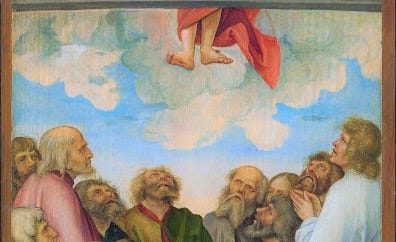
For most of Christian history, the mechanics of the story seemed obvious enough. Jesus rose from the dead, gathered his disciples, blessed them, and then ascended upward into heaven. The three-tiered universe itself appeared to confirm the narrative. Heaven was above. Earth was below. The underworld lay beneath them both. To look upward was to look toward transcendence, towards the stars, and towards God. Then came telescopes, satellites, and NASA. Human beings pierced the clouds and found not choirs of angels but atmosphere, radiation, vacuum, and galaxies—trillions of galaxies— stretching outward beyond comprehension. The old three-tiered universe dissolved somewhere between Copernicus and Carl Sagan. The sky no longer functioned as the visible boundary between the human and divine worlds. “Up” stopped working.
And yet the church still reads the Ascension every year.
In the Book of Acts, the resurrected Jesus gathers his disciples for one final conversation. They ask him the sort of question people always ask messianic figures: “Lord, is this the time when you will restore the kingdom to Israel?” In other words: Is the revolution finally happening now? Will power finally change hands? Will Rome fall? Will justice finally arrive? Jesus refuses the timetable. “It is not for you to know the times or periods that the Father has set by his own authority.” Then he says something far more important: “You will receive power when the Holy Spirit has come upon you; and you will be my witnesses in Jerusalem, in all Judea and Samaria, and to the ends of the earth.”
Then he ascends. Up, Up and away? The disciples stand staring upward into the sky until two angels interrupt them with what may be one of the strangest questions in scripture: “Men of Galilee, why do you stand looking up toward heaven?” The question lands differently now than it once did. For centuries Christians heard the Ascension primarily as a statement about where Jesus went. But the deeper movement of the story is not vertical transportation. It is vocational redirection. Jesus goes up. The disciples go out.
That distinction matters because over the last two thousand years many Christians have been trained to read scripture in ways that steadily evacuate its historical force. That is, we have made it about ‘in heaven as in heaven’ and not, as the Lord’s prayer asks us to pray, about “on earth as in heaven.” We have learned to interpret the gospel as spiritual rather than economic, private rather than public, heavenly rather than historical, individual rather than communal, moral rather than structural, devotional rather than political. Stories deeply concerned with land, debt, hunger, wealth, incarceration, hierarchy, empire, and exclusion have often been transformed into spiritual stories almost entirely about interior religious experience—about Jesus in my heart but no longer flipping tables in the square.
Politics and Religion
Many people speak as though politics has no place in religion—as though Christianity was once purely spiritual until modern activists dragged it into public life. But this misunderstands both politics and the New Testament. Politics, in its broadest sense, concerns the ordering of human life together: power, law, labor, violence, institutions, hierarchy, and belonging—and the Bible has a great deal to say about these things. So did Jesus. So do the Gospels. They speak constantly about debts and hunger, land and status, prisoners and widows, exclusion and mercy. The question is not whether Christianity has political implications. The question is what kind of politics emerges from the teachings of Jesus.
We have learned to interpret the gospel as spiritual rather than economic, private rather than public, heavenly rather than historical, individual rather than communal, moral rather than structural, devotional rather than political.
The Gospel of Luke, paired with Acts as a two-volume narrative, is saturated with precisely these concerns. Mary sings that God has “brought down the powerful from their thrones and lifted up the lowly.” Jesus announces good news to the poor, release to captives, and sight to the blind. He warns the rich constantly. He speaks obsessively about debts, landowners, widows, prisoners, banquets, hunger, and status. He crosses ethnic boundaries, praises Samaritans, eats with sinners, and tells stories in which the moral heroes are often foreigners and social outcasts. None of this is accidental background scenery. It is the substance of the kingdom he announces.
Modern Christians often hear the phrase “you will be my witnesses” primarily as a command to evangelize, spread doctrine, or increase church membership. But in Luke-Acts witness means something larger and more dangerous. A witness is not merely someone who talks about Jesus. A witness is someone whose life becomes evidence that another kind of world is possible. That is why the geography in Acts matters so much.
Jerusalem, Judea, Samaria, and the ends of the earth
Jerusalem, Judea, Samaria, and the ends of the earth are not merely coordinates on a map. They represent the widening radius of moral concern. Especially Samaria. The movement of the gospel is always toward the people respectable religion avoids: outsiders, enemies, foreigners, and populations considered contaminated, dangerous, or expendable. The Spirit keeps dragging the church across boundaries it desperately wants to preserve.
This raises an uncomfortable historical question: What exactly got Jesus killed? Christians sometimes answer this so abstractly that the crucifixion becomes detached from history itself. Jesus died “for our sins,” which may be true theologically, but the statement can become vague enough to obscure the concrete political reality that Rome publicly executed him under charges associated with sedition and kingship. Empires do not crucify people for being generally kind. Jesus could have wandered Galilee performing occasional miracles of charity. Rome tolerated charity. Every society tolerates charity because charity relieves pressure without threatening the structure itself. He could have healed blind men so they could return to work Monday morning. He could have cured the lame and deaf as isolated acts of compassion. Rome tolerated wandering healers and eccentric holy men. He could even have hosted dinners where prostitutes and sinners were treated with dignity. Empires can survive moral eccentricity.
But what empires do not tolerate are alternative social imaginations.
Jesus did something more dangerous than isolated kindness. He named the systems producing suffering. He accused elites of “devouring widows’ houses.” He attacked religious performance masking exploitation. He disrupted the economic machinery of the Temple. He warned repeatedly about wealth accumulated through extraction and privilege. He proclaimed a kingdom whose values contradicted domination, humiliation, exclusion, and hierarchy. The cross was not Rome’s punishment for kindness. It was Rome’s response to a movement that threatened the existing order.
Separating Suffering from Structure
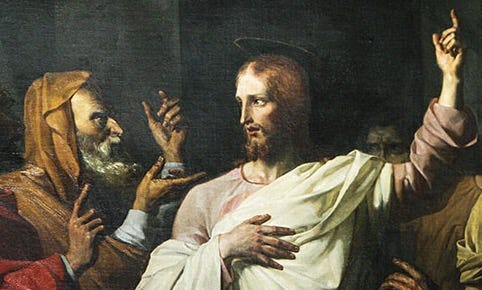
That distinction remains difficult because modern Christianity often prefers victims without asking what produces them. Bishop Câmara, the Brazilian Catholic archbishop and liberation theology figure is quoted as saying, “When I give food to the poor, they call me a saint. When I ask why the poor have no food, they call me a communist.”
Feeding the hungry is praised. Asking why people remain hungry becomes political. Sheltering the homeless is celebrated. Interrogating housing systems, wages, speculation, healthcare, addiction, or public policy becomes political. Caring for prisoners is admirable. Questioning the machinery producing endless prisoners becomes political. And yet the Gospel of Luke consistently refuses to separate suffering from structure. The widow matters, but so does the system devouring widows’ houses. The prisoner matters, but so does the machinery producing prisoners. The hungry matter, but so do the arrangements concentrating wealth upward while entire populations sink into precarity below.

This is why the Ascension matters politically, though not in the shallow sense. When Jesus ascends, the responsibility descends onto the community - on to us. The body of Christ disappears in one form so it can reappear in another. The disciples are not instructed to build an escape route to heaven. They are told to become witnesses “to the ends of the earth.” And this is where contemporary Christianity often fractures.
So many Christians, rediscovering the public implications of faith, have embraced forms of domination dressed in religious language. Christian nationalism fuses divine purpose with national identity until the state itself becomes quasi-sacred (Golden calf anyone?). The New Apostolic Reformation movement increasingly imagines Christians “taking back” society through structures of control and influence, often through the Seven Mountain Mandate of conquering media, government, education, and culture. In these visions, “being sent out” begins to resemble conquest.
The Acts of the Apostles
But the movement of Acts is different. The apostles are not sent out to seize Rome, they are sent out to embody another way of being human within Rome. The church’s political task is not domination but witness, and witness is costly precisely because it refuses both withdrawal from politics and conquest of politics. The church cannot retreat into purely private spirituality, pretending suffering is merely an unfortunate backdrop to individual salvation. But neither can it become another instrument of tribal power, baptizing domination with religious language. The temptation toward escape has always been strong. It is easier to speculate about heaven than confront systems. Easier to argue metaphysics than stand beside people crushed by debt, violence, addiction, loneliness, exploitation, or humiliation. Easier to reduce the gospel to private morality than to ask what human life would look like if Jesus actually meant what he said about wealth, enemies, status, and power.
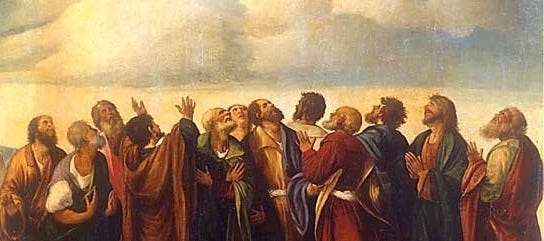
This is why the angels interrupt the disciples. “Why do you stand looking up toward heaven?” Because religious people often prefer transcendence to responsibility. The church keeps trying to escape history while the Spirit keeps sending it back into it. This does not mean Christianity can be reduced to activism. The gospel is not merely a political program with stained-glass windows. Christianity concerns prayer, forgiveness, worship, beauty, contemplation, transcendence, and eternal life. But the New Testament refuses to separate these realities from embodied human existence. “Thy kingdom come” is not merely about heaven after death. It is about organizing human life now.
Modern cosmology, oddly enough, may clarify the Ascension rather than destroy it. Once “up” stops functioning literally, Christians are forced to ask what the story was trying to say all along. Perhaps the Ascension was never fundamentally about divine levitation. Perhaps it was about authority transferred into witness.
After the Ascension comes Pentecost—the as promised other advocate of the Spirit that blows mightily upon the early church—shared property, economic redistribution, boundary crossing, imprisonment, confrontation with authorities, conflict with empire an persecution. Acts is not the story of a religious community retreating from history. It is the story of a Spirit-driven people becoming more entangled with history than ever before.
The Bible itself emerged from communities struggling to survive empire. It is not a timeless abstraction floating above history but a library produced inside history by people wrestling with power, suffering, and hope in real time. The question, then, is not whether Christianity is political. The question is whether Christians will allow their politics to be shaped by the crucified Christ rather than by the endless human appetite for domination. To follow Jesus politically does not require partisan uniformity. Democracies require argument, compromise, and disagreement. But it does require becoming unable to ignore suffering once one understands what produces it. It requires applying the teachings of Jesus not only to private morality or individual spirituality but also to systems, institutions, economies, and public life.
And perhaps that is why the Ascension story ends the way it does. The disciples stop staring upward and return to Jerusalem — back to the city, back to uncertainty, back to conflict, back to one another, back to the suffering world history refuses to let them escape. The movement of the gospel after Ascension is not away from earth but deeper into it. Not withdrawal from human struggle but immersion within it. The angels interrupt the disciples’ upward gaze because the church cannot spend its life looking toward heaven while human beings are being crushed below. The Spirit is always pulling the church back into history: into systems and structures, into neighborhoods and nations, into the long unfinished work of learning what love looks like when it is practiced in public.


Trump’s Blasphemy Is Worse Than David French Thinks

I was told last week to stay out of politics. My reply was simple:
Thanks for spending time in the Studio with me.

Absolutely insightful! Thank you! Wish this could be preached from every pulpit on Ascension Sunday.
Thanks for this.
Verticality is the basis of Empire rule - of monarchy and dictatorship. The model of Ruler at the top, ruled at the bottom, is a human template that people imposed on spirituality, as you say, because of where the sky is, where dead bodies go, and where we live, “the known world.”
And you are right, people don’t look into the sky for God any more…not scientists and not ordinary people.
The axis of Jesus’ “kingdom” isn’t on the world’s template. God is found on the axis Outward/Inward. In my humble opinion! So why does Jesus ascend, only to have the two angels tell people to seek him by going out from the center, and thus anchoring on the center, of a horizontal plane?
I think it’s because Luke/Acts, like all the Gospels, was written in the generation after Christ was arrested and killed by Roman political lackeys.
This is exegesis, not part of the sermon. Exegesis tells me that these two angels are speaking to the disciples who wrote it down, to Luke & Company, and to us. When they were children, perhaps they heard the story of Christ’s vertical ascension. But as disciples, inheritors and workers in the new world Christ opened, they wrote the story as their angels dictated it to them, the grownup way.
I say, the danger in Christianity is not from retelling the news in contemporary terms, but from failing to do so. MAGAheads look up and down. They admire golden escalators, “stairways to heaven” like the kind Hegseth and Patel use. They seek the top, not the center, not the far-flung edge.
In the world, up and down are meaningless. Go to the Southern Hemisphere and what’s down is up, what’s up is down. Gravity makes up and down relative to where you happen to be. To value up positively and down negatively is archaic, primitive, and superstitious.
But inward and outward are meaningful, wherever you stand in relation to gravity.